Saturday, April 13, 2013

Looking to see a Movie this weekend?


 Don’t miss “Renoir”.  The recent French film by director Gilles Bourdos depicts the painter Pierre August Renoir’s last years when he lived in the South of France .  1915, WWI was raging , Renoir both sons had been injured at the front and he had just lost his wife Aline.  He lived in the Cote d'Azur, at the Domaine des Collettes , a  9 acre estate a few kilometers from Nice, surrounded by a retinue of devoted servants who tended to his needs and care.  As the movie depicts, Renoir hands were deformed due to  crippling rheumatism which made it difficult for him to paint.  He nevertheless worked at his easel as painting was his raison d'etre.  One day,  a young beautiful model and aspiring actress shows up at his doorstep. She is bringing in the life's of the elderly painter much excitement and vitality.  She is to become his muse and last favorite model. I will not divulge anymore of the plot not to spoil your own viewing. 

I recommend this movie (and I have seen it twice ) for its cinematography as it portrays Renoir's lush garden at les Collettes .  It is like stepping into the painter’s canvas.   Needless to say the acting  is superb notably  by veteran actor Michel Bouquet as Renoir.   So enjoy !! 

Renoir
By the way, Renoir 's Estate - Domaine des Collettes - is now a museum located in Cagnes sur Mer and can be visited.  However,
the garden used to depict the domaine des Collettes is Domaine du Rayol - a mediterranean garden in the var region at the foot of the Massif des Maures facing the Hyieres Islands.


Farm at les Colletttes- Renoir
Tag: Renoir, Cote d'Azur, Domaine des Collettes

Monday, March 18, 2013

André Le Nôtre- The King’s Gardner


Andre le Notre

This year marks the 400 anniversary of the birth of– André le Nôtre- the landscape designer of a number of prestigious French gardens and notably Versailles, Vaux le Vicomte, Chantilly, Fontainebleau and the Tuileries just to name a few.  In the 17th century he revolutionized the art of landscaped gardens and was the master of the French formal garden style ‘Jardin a la Francaise”. His legacy endures today. 

Born March 12, 1613, Andre Le Notre comes from a family of gardeners—both his father and grand-father were in charge of the royal gardens at the Tuileries Palace.  As a young man, he studied architecture and enrolled in the workshop of painter Simon Vouet where he learned classical art and perspective. There he met his friend and future collaborator painter/decorator Charles Le Brun and architect Francois Mansart.

In 1637, Le Notre took over the position of his father as head gardener at the Tuileries which he redesigned and where he created the expansive vista that became later the avenue des Champs Elysees. 

Vaux le Vicomte- Photo Parc et Jardin
Le Notre’s fortune and glory became solidly established when he was hired by Louis XIV's finance minister, Nicholas Fouquet to design the garden of his brand new castle at Vaux le Vicomte just southeast of Paris, near Melun. He designed symmetrical borders framed in low boxwoods and yews, neat gravel pathways lined with statues, expansive vistas, large basins with fountain works and grottoes  The result was so magisterial, that King Louis XIV upon his visit to Vaux le Vicomte got so envious that he arrested Fouquet. 


Subsequently, Louis XIV undertook the renovation and expansion of his modest hutting lodge at Versailles.  For that he hired the architect Le Vau, the decorator le Brun and the landscape designer Le Notre –all three had worked together at Vaux le Vicomte. 
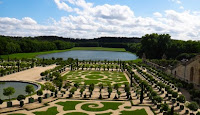
Versailles- Photo Paris City Vision
At Versailles Le Notre refined further his gardening concepts:  symmetrical walks and side alleys that lead to groves, parterres of greenery, large perspectives, clipped edges, artful topiaries, canals and fountains, classical statues, fanciful grottoes, labyrinths and even fireworks.  It took 40 years for the work to be completed.


Domaine de Chantilly- Oise Tourisme
In 1663, Andre Le Notre worked on the garden of another grand Chateau at Chantilly commissioned by its owner the Grand Conde.  Here, water reigns supreme.  A large expanse of water is bordered by symmetrical parterres. Of all the gardens designed by le Notre, Chantilly was his favorite. 


This year a program of celebrations of Le Notre's works will take place at Versailles, Vaux le Vicomte, Chantilly and the Louvre. 

Versailles Le Notre en Perspective – 22 october to February 24, 2014 .
This exhibit will paint for  visitors an image of the multitalented man- designer, architect, planner, painter, visionary… 

In addtion, Versailles will feature the restoration of the Latone Fountain and throughout the summer there will be fireworks celebrations in honor of Le Notre. 

At Vaux le Vicomte, an exhibit on Le Notre will start April 12.  There will be an  audio visual display explaining the different stages of the construction of the garden and directed walks through the gardens will explain the optical illusions and surprising perspectives of the garden.  Also architect Louis Benech will design  a new flower garden this spring taking his inspiration from Le Notre. 

At Chantilly- Exhibit: "Le Notre and the Gardens at Chantilly in the 17th and 18th Century" - at Salle du Jeu de Paume, April 12-July 7.

In the Tuileries  from  May 25-September 30,  there will be exhibition walks in the garden organized by the Louvre explaining the main elements of Le Notre's design.  

 Tag: Andre le Notre, Versailles, Vaux le Vicomte, Chantilly

Friday, March 8, 2013

International Women's Day


Today is  International Women Day !! To mark this event, I would like to feature four French women who have had an impact on French history and culture and whose legacy still endures.   

Joan of Arc—(1412-1431).  At the age of 16, following visions and celestial voices that commanded her to deliver France, the "Pucelle" from Domremy set out to Chinon to convince the Dauphin Charles VII to let her lead an army against the English occupiers during the Hundred Years War.  A number of victories followed notably in lifting the siege of Orleans.  This led the way for the dauphin Charles VII to enter Reims where he was crowned King.  Though burned at the stake at the age of 19, Joan of Arc legend endures and has become an emblem for France's nationalism and freedom.  


Madame Vigier le Brun—(1755- 1842) -- Elisabeth Vigee le Brun was a successful court painter and a favorite portraitist of Marie Antoinette. Her exceptional artistic talent led her to be a member of the prestigious Royal Academy of Painting in  1775.  She left France at the start of the French Revolution and found protection and work in different courts of Europe –Italy, Vienne, London, and St . Petersbourg . She Returned in France in 1802 to much acclaim and continued painting till her death.  Her exquisite paintings are on view at the Louvre and many museums around the world. 


George Sand – (1804-1876) This 19th century French writer , nee Aurore Dupin, was an early feminist.  A wealthy aristocratic landowner from the Berry Province, George Sand is known for her novel La Petite Fadette et La Mare Au Diable.  She was a political essayist who espoused socialist issues.  In order to circulate more freely in the Parisian literary world of  the mid 19th century, she sported men’s clothing and against social codes of the time even was seen smoking in public.  She had a long amorous affaire with pianist and composer Frederic Chopin.


Marie Curie—(1867-1934) – Born in Poland, Marie Curie studied and worked in France as a renowned scientist.  She along with her husband, Pierre Curie  researched radioactivity. She was the first women ever to win a Nobel Prize  and is the only woman to win the award in two different fields (physics and chemistry).  It should be noted that she shared the award with  her husband and a collaborator, Pierre Becquerel.   She was also the first women to ever teach at the University of Paris Sorbonne and  the only women to be entered at the Pantheon on her own merits.


Coco Chanel- (1883-1971) – Gabrielle Coco Chanel revolutionized the way women dressed.  She is credited for liberating women from the constraints of the corset.  Her creations emphasized a more natural body silhouette, fluid, at ease yet stylish and sophisticated. During a long and prolific career,  her contributions to the world of couture included the knitted jersey Chanel suit and  the little black dress; they are still popular and stylish today as they were nearly  a hundred years ago.


Friday, March 1, 2013

French Popes in Avignon


It is the first time in 600 years that a pope retires from office.  This is a significant historical event  since  popes have held their pastoral duties till their death. For a period between 1309 to 1376, seven popes resided in Avignon, the picturesque  town in southern France which was at the time an independent city-state.  It started with a strife between Pope  Boniface VIII,  his successor Benedict XI and the King of France Philip IV.  After a deadlocked conclave , a French cleric was elected taking the name of Clement V in 1305. The new pope refused to move to Rome and instead set up court in Avignon.  A total of seven popes reigned in Avignon where they built a huge palace. In summer, they would retreat to their country residence , just a few miles north of Avignon in the village of Chateauneuf-du-Pape where they planted vineyards.

In 1376, Gregory XI left Avignon and moved the papal court back to Rome ending the Avignon Papacy.  Upon his death, a Roman mob demanded an Italian  pope (preferably Roman).. Under pressure the conclave elected Urban VI (not a Roman but a subject of Queen Joan of Naples).  A reformist, he immediately made clear that never again would the papal court move to Avignon. French cardinals immediately clashed with the new pope and they started to conspire against him.  They issued a manifesto of grievances and declared his election invalid since they felt they had been pressured by the Roman mob to elect an Italian.    The cardinals then proceeded in electing a new pope – Clement VII, the "Antipope", giving rise to a split within the Catholic Church known as the Western Schism when two men claimed to be the true pope.  Clement VII re-established the papal court in Avignon in 1378 that lasted until the Council of Constance in 1417 reunited the factions and  re-established one pope to be residing in Rome.
 
The popes’ legacy in Avignon still stands today.  The palace is the largest medieval gothic building in Europe. It is in fact made of two building- the Old Palace of Benedict XII and the new palace of Clement VI.  In all six papal conclaves were held there in the 14th century- the last one in 1394 at the election of antipope Benedict XIII. 

Since 1995 the Pope's Palace has been on the list of UNESCO World Heritage sites and is a popular tourist attraction as well as a center for culture as many performances, notably during the renowned Avignon Festival, take place within its austere walls.


 It is interesting to note that Avignon and the nearby Comtat Venaissin were under Papal control till 1791 when it was annexed by France.  

Tag: Avignon, Pope's Palace, Popes in Avignon

Monday, February 18, 2013

Winter Festivals on the French Riviera

While most of France is shivering in cold  February,  the Cote d'Azur enjoys sunny days and mild temperatures, perfect weather to celebrate  with parades the traditional Mardi Gras Carnival as well as festivals dedicated to the local production of lemons and mimosa flower.

Nice Carnival- Courtesy Nice OT
 Parades,  flower decorated floats and revelers fill the streets of Nice to cheer the King of Carnival and its court - all giant figures made of colorful paper-mâché. This year, the theme of Carnival is "King of Five Continents" and for fifteen days (February 15-March 6), day and night,  parades of flower bedecked floats accompanied by thousands of musicians will snake along the coastal seafront on Promenade des Anglais and Avenue Massena, Nice's main artery, loudly cheered by delirious crowds. Unique to Nice's carnival are the flower battles in which at top floats armful of flowers are tossed to the happy crowds. Ninety percent of the flowers used at the parades are produced locally --jasmine, gladiolus, mimosa, daisies, carnations and roses --allowing  the region on this occasion to showcase the quality and variety of its local production.

If Mardi Gras revelry was not enough, celebrants can enjoy two other  traditional festivals on the Côte d'Azur honoring local products- Menton's famous lemon and the Mimosa Festival in Mandelieu la Napoule.
Menton Lemon Festival

This year marks the 80th anniversary of the Menton Lemon Festival, one of the French Riviera most popular events.  For two weeks in February, this pretty sunny  town on the border of France and Italy celebrates the local citrus with parade floats and giant artistic arrangements made of  the yellow and orange fruits.( February 16-March 16).  http://www.fete-du-citron.com/


Mimosa Festival-
Courtesy Mandelieu la Napoule
Not to be outdone,  the coastal resort town of Mandelieu la Napoule, situated a few kilometers west of Nice celebrates the local mimosa.  This  flower originally from Australia was introduced  in Esterel and Tanneron massifs in the mid 19th century and when  the mimosa blooms in January and February covering  the countryside in vivid yellow carpets, it is time  for  Mandelieu to invite the world to  discover and celebrate the flower that made the town and region's fortune as it is used in perfume with what else?... parades, floats, artistic floral displays, flower battles and musical  entertainment.
(February 15-24) http://www.mandelieu.com


tags: French Riviera, Nice Carnival, Menton Lemon Festival, Mimosa Festival in Mandelieu la Napoule

Friday, February 8, 2013

Spring in Provence... A tour to Remember


Provence Escapade Escorted Tour


Avignon
This spring discover the best  Provence has to offer.

Join our small group for a memorable journey through Provence. Together, we will explore the many treasures of this sunny land from its rich historical past to its unique traditions and savoir vivre. You will discover beautiful architecture dating back to the Romans and magnificent landscapes of fragrant hills, lavender fields, vineyards and picturesque villages. More importantly, on this journey you will find your senses stimulated in so many ways from the special light that inspired the impressionist painters to the smell and taste of the many Provencal specialties.

Date: May 18-23, 2013

Save: $100 per person if booked by February 28

Point du Gard
  • Medieval heritage: Avignon's Pope's PalaceSte. Trophime CathedralAbbaye de Senanque
  • Roman architecture : Pont Du Gard ; Arles' Arena and Vaison la Romaine
  • Irresistible Provencal towns: Avignon ; St. Remy de Provence; Aix en Provence
  • Picturesque perched villages: Gordesles Baux; Roussillon
  • Savoir vivre :: colorful markets ; Chateauneuf du Pape wine tasting; olive oil tasting
  • Beautiful landscape : Alpilles Hills; Luberon National Park; vineyards and lavender fields
  • Discover Marseille – European Cultural Capital 2013


Provence market


www.enchanted-france.com

tags: Provence, tour, Avignon, Saint Remy de Provence, Aix en Provence, Marseile

Wednesday, February 6, 2013

Hop on HOP!


Air France KLM announced last week a new low cost airline to debut end of March.  It will offer 530 daily flights to  136 destinations within France and many European cities notably to Barcelona, Rome, Bologna, Florence, Geneva, Prague, Venice, Vienna Budapest, Dusseldorf, Brussels,  Milan , Naples.  This will make Paris a great point to jump start your European journeys. 

Here is a selection of low cost airlines with flights from/to Paris :
Hop! by Airfance-KLM   http://www.hop.fr
Easy Jet http://www.easyjet.com
Ryan Air (from Beauvais airport) http://www.ryanair.com
Vueling  http://www.vueling.com
Air Berlin http://www.airberlin.com